

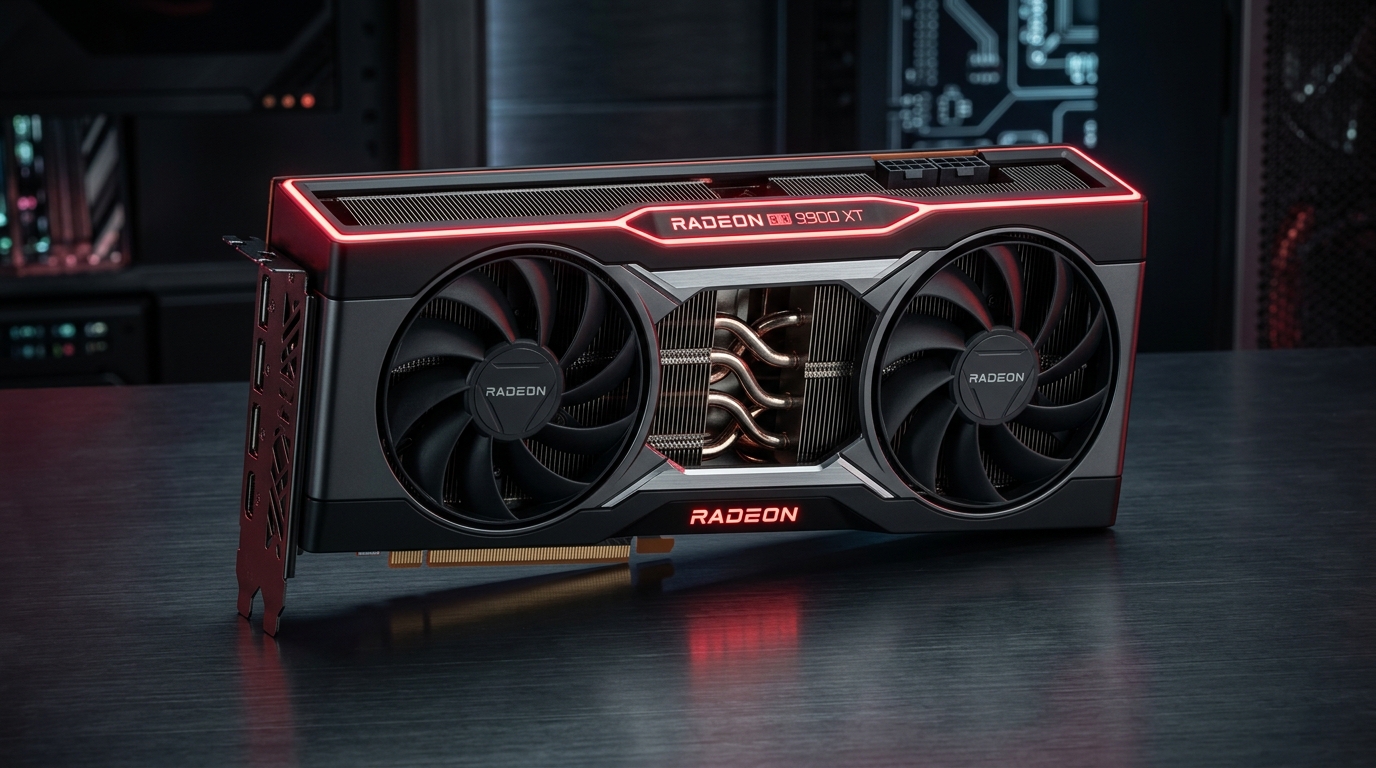
After skipping the ultra-enthusiast tier during the RDNA 4 cycle to focus entirely on mid-range dominance, AMD is officially re-entering the heavyweight arena. During their latest hardware keynote, AMD lifted the embargo on the RDNA 5 architecture, confirming that the new Radeon RX 9000 series will hit retail shelves in late October 2026.
Promising a complete architectural overhaul rather than a simple node shrink, RDNA 5 integrates advanced AI-driven upscaling natively into the silicon and adopts next-generation GDDR7 memory. Ahead of our full review embargo next month, here is everything you need to know about the RX 9070 XT and the RDNA 5 architecture.
RDNA 5: A True Architectural Overhaul
While RDNA 4 succeeded in providing budget-friendly 1440p performance, it reused heavily iterated components from RDNA 3. RDNA 5 is a from-the-ground-up redesign focused heavily on eliminating AMD’s historical ray-tracing deficit.
- Dedicated AI Tensor Cores: For the first time, AMD is moving away from purely shader-based upscaling. RDNA 5 silicon features dedicated on-die matrix accelerators designed exclusively to run FSR 4.1, bringing AMD’s image reconstruction and frame generation on par with NVIDIA’s DLSS 3.5.
- Next-Gen Ray Accelerators: RDNA 5 significantly increases BVH (Bounding Volume Hierarchy) throughput. AMD claims a staggering +60% increase in path-tracing performance over the RX 8800 XT, finally allowing Radeon cards to run titles like Cyberpunk 2077 and Alan Wake 2 with full Overdrive mode enabled.
- Chiplet Design 2.0: AMD has refined its multi-chip module (MCM) packaging, drastically reducing the latency penalty between the Graphics Compute Die (GCD) and the Memory Cache Dies (MCD).
Radeon RX 9070 XT: The 1440p & 4K Sweet Spot
The first card leading the October charge will be the Radeon RX 9070 XT, positioned directly against NVIDIA’s aggressive upper-mid-range stack.
Confirmed Specs & Targets
- Architecture: RDNA 5 (TSMC 3nm process)
- VRAM: 16GB GDDR7 (28 Gbps)
- Bus Width: 256-bit
- Target TDP: 275W
- Display Interface: DisplayPort 2.1a (UHBR20 for uncompressed 8K/240Hz 4K)
With the inclusion of GDDR7 memory, the memory bandwidth limitation that held back previous Radeon cards at 4K resolution is entirely eliminated. The 16GB VRAM buffer also ensures the RX 9070 XT remains fully capable of handling massive Unreal Engine 5 Nanite geometry loads over the next several years.
Release Date & Expected Pricing
AMD has confirmed that the first wave of RDNA 5 AIB (Add-In Board) partner cards from Sapphire, PowerColor, and ASUS will officially launch on October 22, 2026.
While official MSRPs remain closely guarded, industry analysts expect the RX 9070 XT to launch competitively between $649 and $699, forcing aggressive price corrections across the entire desktop GPU market ahead of the holiday shopping season.
Planning to build an entirely new rig for RDNA 5? Make sure you pair it with the right processor. Read our deep-dive review on the AMD Ryzen 7 9800X3D vs 7800X3D to prevent CPU bottlenecks.
Final Takeaway: RDNA 5 represents AMD’s most ambitious GPU launch in a decade. By tackling ray-tracing head-on and adopting hardware-accelerated AI upscaling, the RX 9000 series might finally break the enthusiast monopoly. Check back in late October for our full synthetic and gaming benchmark review.



Discussion & Responses